Where Roots Grow Deep
Ðǿմ«ý alumnus and Franklin mayor Stacy Guffey, ’99 is shaping the future of the American South by honoring its past.
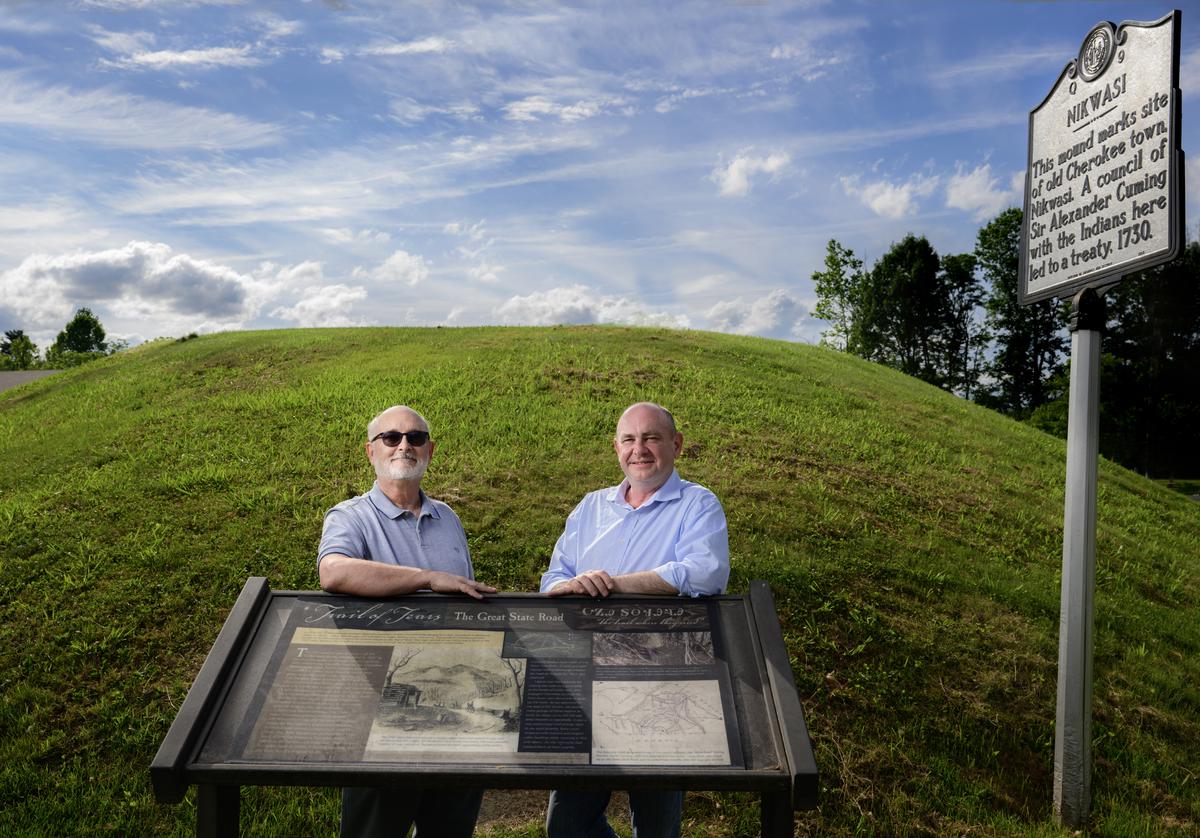
The recent and celebratory return of the Nikwasi Mound to the Eastern Band of Cherokee Indians and the revitalization of the Cowee School Arts and Heritage Center are two pivotal moments in the town of Franklin’s history that Guffey has proudly helped advance.
The area’s continued growth and cultural development, especially in this fraught political era, speaks to the importance of forward-thinking leadership that’s rooted in and empowered by a deep respect for the land and its people.
Stacy is one in a long line of Guffey’s to grow up in Macon County.
And when he speaks about his mountain upbringing alongside generations of his family, it’s clear how profoundly he feels it’s shaped his outlook.
“One of the best parts of growing up here was the longevity of my great grandparents, not only being able to know them but spending time living with them and being a part of their lifestyle, which is so much different,” Guffey said. “It’s crazy to think about being a kid growing up with all these modern amenities and interacting with people who went around on a horse.”
For Guffey, sharing that life meant learning to churn butter. To kill a chicken by the age of 6. It was understanding what roots and dyes were best for basket-weaving, honeysuckle or white oak or bloodroot or black walnut. How to quilt and how to cook sweet potatoes every which way.
And it was about telling stories.
“Being constantly reminded of the names and stories of your ancestors, exactly where they lived, which cabin was theirs, which land they farmed, which mountains they hunted on or got ramps and things... You develop a connection,” Guffey said.
He felt that connection to his ancestors with a special keenness as his son went to work on the very same farmland his father had.
“I think about how these people have farmed it. How they lived and died on it, you know. They sweated into the ground and bled into the ground... There’s a certain kind of roots you have if you’re connected to all of that past, and I’m sure that’s part of my motivation to do public service,”
And Guffey had an early example of that compassion in his grandfather’s church. Though Guffey didn’t become a preacher as so many men had in his family, he followed in their footsteps, nonetheless.
“After I got into public service, he asked me, ‘Why did you get into politics and public service?’ And I said, ‘From watching you. I saw you do politics in the church to hold the church together. I saw you do public service every time somebody was sick. He was there when somebody was dying. He was there when people in the community needed wood or needed a ramp built or something like that. He was always there doing public service in a different way motivated by different things,’” Guffey said. “‘I grew up with a respect for that... There was something it instilled in me.’”
Guffey continued an English education he began in Puerto Rico at Southwestern Community College and transferred to Ðǿմ«ý a short time later. He earned his bachelor’s degree in English Literature with a host of new challenges, among them learning how to be a single father, and explained in that pivotal period of his life how professors like Sister Mary Warner helped him through and how new skills and new ideas led him forward.
“Sometimes it bothers me that people talk about college degrees in terms of just pure return on investment... I’m sure people would say ‘Don’t get an English literature degree because if you get an engineering degree or learn to be a plumber or something like that you make more money,’” Guffey said.
“But when people say that I always think like ‘You’re missing the point.’ Because that English degree for me was so much more valuable in terms of how I enriched my life. It gave me perspectives I wouldn’t have had. I read things I would not have read. I learned from people I would not have met,” Guffey continued.
Those experiences and conversations enabled Guffey to participate in the political and advocacy conversations he’d later lead.
“There’s not a day that goes by that writing is not extremely critical to my career,” Guffey said. “Without the English degree, I don’t think I could write the way I write. I don’t think I could do public speaking.”
Though Guffey didn’t immediately enter the realm of politics after graduating, his time at Ðǿմ«ý set up a seed that would come to bloom from the very same land he’d grown on.
Guffey’s first foray into the professional world was with Ðǿմ«ý’s public information department, where he helped with web design work and communications. But after a brief stint there, Guffey decided to join the staff of Southwestern Community College.
They were good and fulfilling years, says Guffey. At that point in the early 2000s, the e-commerce program Guffey helped establish at the college was the very first of its kind in the nation.
At the same time, in his private life, he was reckoning with and exploring a newfound sense of responsibility to the region he’d forever call home.
In that same period after his graduation, Guffey and his family witnessed the land around their farm transformed, developed and privatized. Fences were erected; “no trespassing” signs were put up, and suddenly the territory they’d known so long to be wide and open was boundaried.
“I remember a particular moment when I decided that it was time to do something while sitting on the porch out at the farm. There’s this mountain that we look at every year and in the fall the colors were incredible, but slowly we were watching these big, giant houses move up the mountain. And you notice that people don’t live in them very often, too, and then there’s this kind of feeling like ‘OK, here’s some rich dude who’s built this house and is looking down on the farm.’ I mean there’s all kinds of feelings associated with it,” Guffey said.
“You’re looking at land that a cousin used to own, that we used to be able to walk across and harvest things off of or go hunting or just hiking. And now it’s closed, and there’s no trespassing signs... everything about it changed,” Guffey continued, “And my family would sit on the porch and complain about it, and they kind of had this attitude that that’s what other families do. We just kind of keep our heads down.
“I remember sitting on that porch one day and saying I’m done with this... I decided to get up and do something, so I started this first group called Macon Tomorrow, and we advocated for good planning practices in Macon County.”
He’d opened a door, and though it was a different kind of future than he’d imagined on the other side, he stepped through.
“The first public service project I did was the Little Tennessee River Greenway. We were building the Greenway, and I realized in that project that if it weren’t for people who had moved here, in terms of ideas, in terms of money and in terms of the time that they had to volunteer...then we wouldn’t have been able to do it, and it was good for me to have that experience really early in my career. I was young, and I realized that people moving in brings something... They bring something new, or they add to the mix something that’s necessary to do innovative projects,” Guffey said.
What Guffey and his collaborators were told would be a big waste of money turned into a public resource used by thousands of people every month, a much-beloved amenity for residents and tourists alike.
He took the nuance in that perspective, the knowledge that residents and non-residents alike can and should collaborate to meaningfully shape the region, and put it to work.
After receiving an invitation from the Macon County’s then-manager, Guffey began to serve as county planner and began what is now his over decade-long career in consulting and development.
His five years in the role, working in the wake of multiple natural disasters, were a rough and tumble lesson in how community leaders can be effective changemakers. The scope of change he’s been involved with since is difficult to understate.
As a consultant, he assisted towns all around western North Carolina and joined a great number of advocacy initiatives, such as Opt-In Southwestern North Carolina, a seven-county economic development initiative, to help uplift the region that raised him however he could.
As University of North Carolina Chapel Hill’s regional program manager for western North Carolina, Guffey helped build other communities up, revitalizing downtowns, increasing entrepreneurship and educating local governments on the steps to get there.
Today, as mayor, Guffey lives on the same main street he’s working every day to reinvigorate, above a Scottish Tartan museum he helped restore. His office is humble, decorated sparsely but for a few woven baskets on the shelf behind his desk, his grandfather’s.
Guffey’s wishes for the future are great, ultimately bending on an urge to serve and to cater to the wishes of long-time residents and newcomers together, through compromise, respect and responsible stewardship of the land.
His path meandered. It took time to hone his passions. But Guffey credits the unexpected with helping shape his philosophy.
“My God, whatever you’re planning on doing probably ain’t going to happen. Because for me, it’s been a wild ride. It’s like I was driving to Atlanta and somehow, I ended up in Albuquerque,” Guffey said.
“You’ve got to be open to opportunities and not afraid of them.
“Everything that’s happened in the past makes you who you are today. And good or bad or whether you were right or whether you were wrong, you should embrace it. And just say, ‘That’s my life.’”